

Façade systems
Structural silicone façade
Glass is bonded to cassette profiles in the shop; units can be set from inside the building.
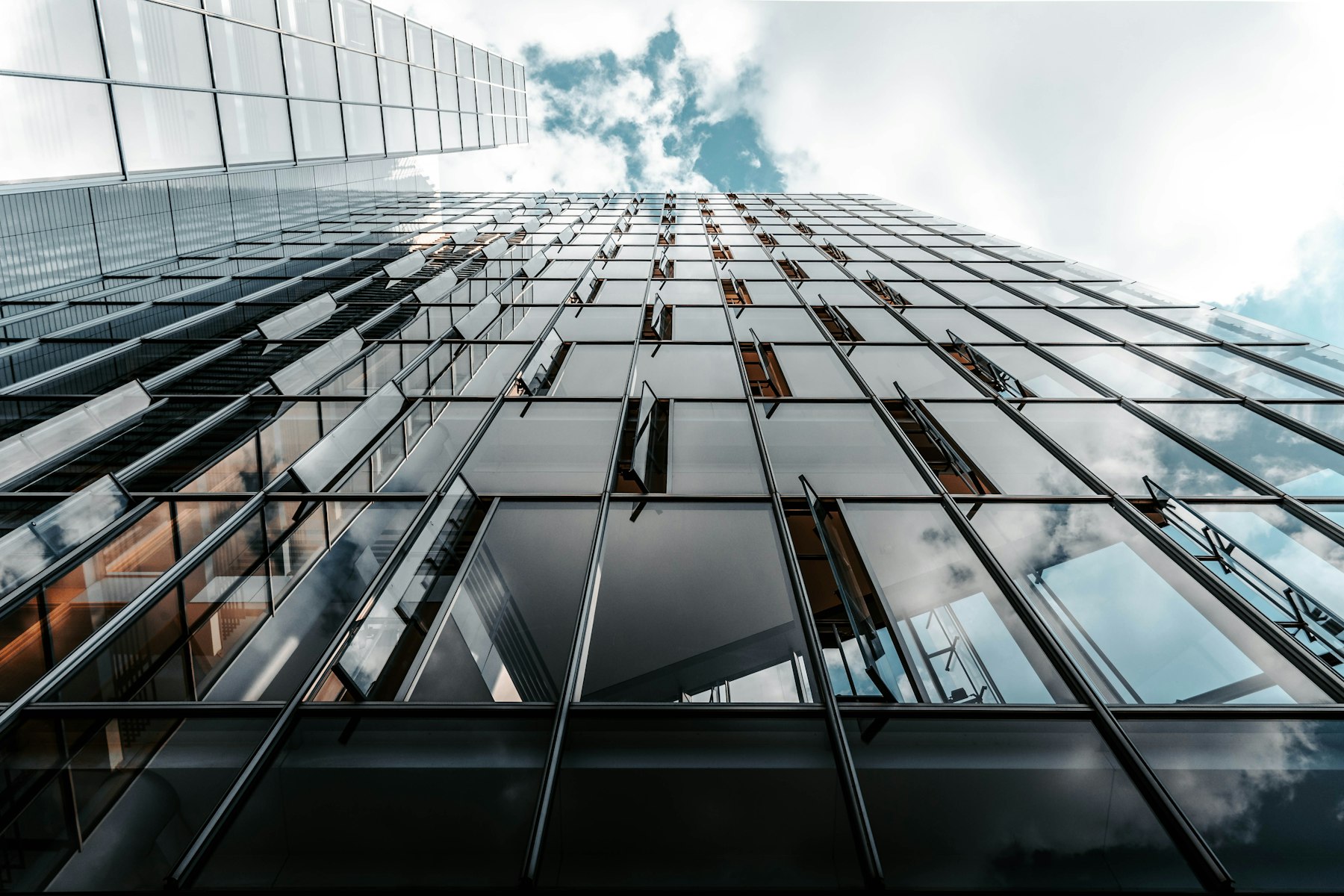
From outside, a structural silicone façade shows nothing but glass. In the shop each pane is bonded to an aluminium cassette frame with structural silicone; on site the cassettes hang on a grid of mullions and transoms. The joints between panes are sealed with silicone, and the façade reads as one uninterrupted surface of glass.
-
Mullion
The vertical member that runs from floor slab to floor slab, fixed to the slab edges with anchor brackets. The cassettes hook into grooves in the mullion to hang on the grid.
-
Cassette frame
The aluminium frame behind the glass. The pane arrives on site already bonded to it; the frame fixes to the mullion, and outside only the glass is seen.
-
Structural silicone
The load-bearing silicone that bonds the glass to the cassette frame. It is applied and cured under controlled conditions in the shop, and it carries the wind load on the glass into the frame.
-
Insulating glass unit
Its outer face is the façade itself, with no profile in front of it. In this system the unit's edge seal is also made with UV-resistant silicone.
-
Joint seal
The joint between two panes is filled with weatherproof silicone in front of a backer rod. This is the façade's outer line of sealing.
Installation
Glass and cassette frame are joined in the shop and left until the silicone has cured. On site the anchor brackets and the grid go up first; the cassettes are hung on the grid and fixed. Last, the joints between panes are closed with a backer rod and silicone. Because the cassettes can be set from inside the building, installation stays practical on tall buildings where scaffolding is hard to put up.
Where it is used
- Headquarters and prestige office buildings
- Hotels and mixed-use towers
- Showrooms and retail façades
- Any building meant to read as uninterrupted glass
When to choose it
When the façade should look like a single surface of glass from outside. It costs more than a capped system and takes more shop work; in return, no profile or cap line shows on the outside.
 Next system
Capped curtain wall
EPDM-gasketed — the most widely used and lowest-cost curtain wall system.
Next system
Capped curtain wall
EPDM-gasketed — the most widely used and lowest-cost curtain wall system.
Request a quote
Send dimensions, drawings or a bill of quantities, and we will come back with a written specification and a quote.